You have taken the leap into the unknown and you’re coming to China to
teach English. Hurrah. You’ve
passed the online TEFL course or the CELTA having googled all the hard grammar
questions (Yes they are all there, I’ve looked, for research of course…). You’ve been to the doctors and given
him 70 quid to check your pulse to certify that you are alive so you can get
your visa and the tickets are booked.
You might end up at a school like this that is proud that its students 'of normal intelligence' will go to universities abroad - if they 'work hard'.

You might end up at a school like this that is proud that its students 'of normal intelligence' will go to universities abroad - if they 'work hard'.

You may or may not have teaching experience it doesn’t matter much
either way. Those of you who are
gap year graduates (see here) have only just finished being students so what do
you know? Oh, I forgot you did a
weekend ‘teaching’ course as part of your 120-hour online TEFL course! Some of
you older, more experienced guys n gals, may not have any teaching experience
at all but want to ‘do something exciting’ and some of you might well be
disgruntled qualified teachers who have jumped the wire and are hot footing it
abroad for an easier life.
Anyway we all come to China for a myriad of different reasons – but we
all come to teach English - don’t
we? And we all want to be successful – don’t we?
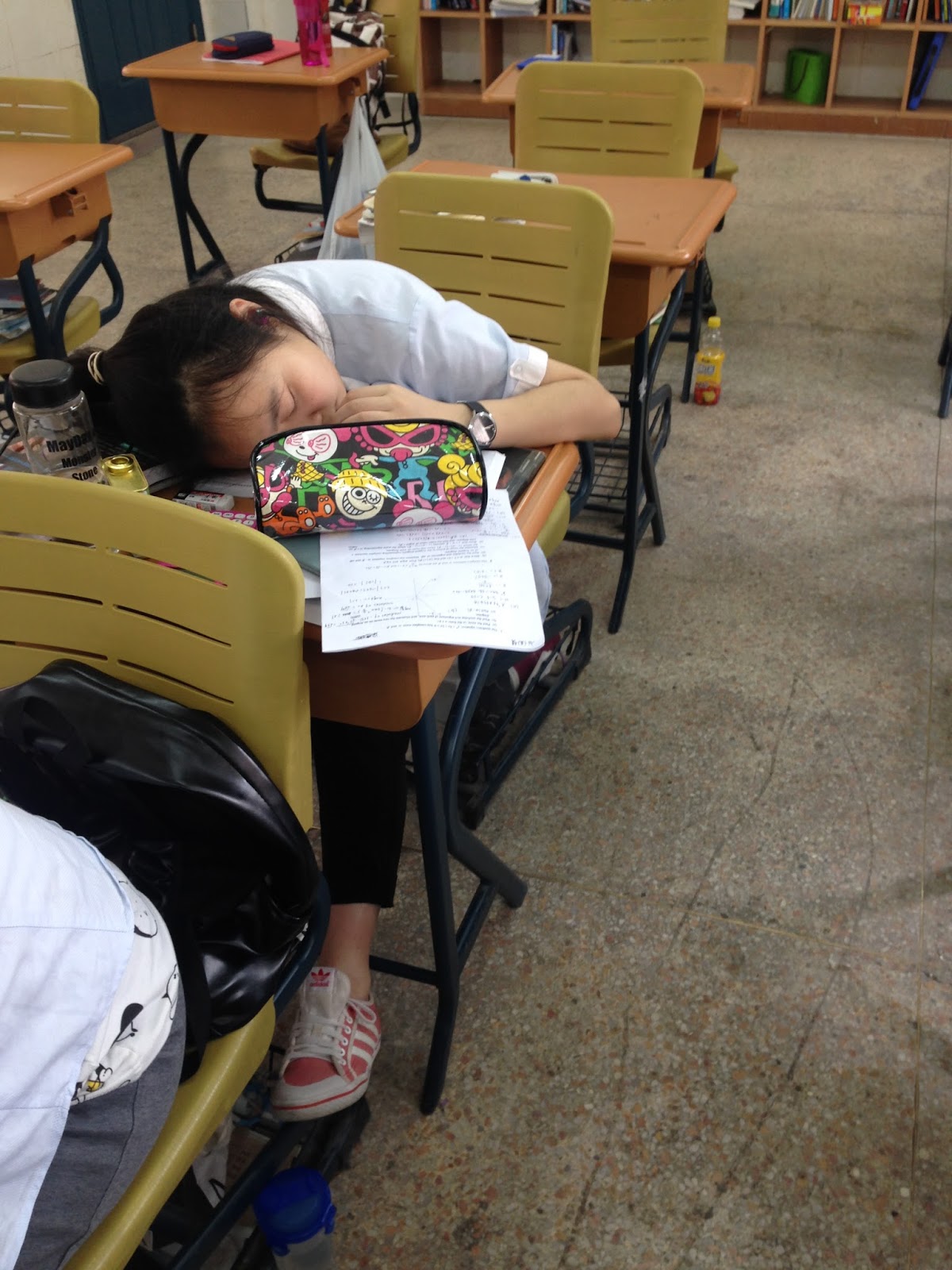
This is me being successful in class - its about 8:30 on a Monday morning - to be fair they are meant to be doing self study for the AS Level exams they have been taking these past few week as well as taking normal lessons 7am to 9pm!.

So how can we be successful
teaching English in a Chinese school?
There are many and varied ways to be successful and we will discuss
these below but first and foremost my advice to you is that when you walk into that classroom on that
fateful first day you will need to lower both your expectations of what you
will achieve in the classroom and your personal expectations of what you actually
can do and how you will feel about it.
This may seem harsh. But its better that you know the truth now rather
than learn the hard way once you are in China. I know that you have worked hard on your CELTA and you were
over the moon when you passed and you sweated over those darn lesson plans. And
you might have 10 years post PGCE experience in tough schools on sink estates in
the back end of Britain but honestly this doesn’t really count for much.
Take me for example. I have
around 20 years teaching in universities as diverse as the OU and Exeter, I
have also taught adult education Social Science to A level and study skills to
beginners at the WEA. OK, this is
not a PGCE but I learnt how to teach the hard way, by just doing it.
When I first came to China I was placed by the agency I contracted with
into the Nanjing College of Information Technology. I was excited to be here. I had come to China because I
thought it would be an exciting experience to be in a country going through
huge changes. It was shrugging off the old yoke of Communism and trying on the mantle of Capitalism – it was Capitalism
with Chinese Characteristics. I
wanted to make a difference. I thought I could come to China and help this
country and its young people develop. I am aware that I would be but a drop in
the ocean, but even an ocean needs its drops to become whole.
You can read more about my experiences by going back to the beginning of
this blog. But I turned up on the
first day excited to be meeting my students. I had two or three different classes who were all studying
on a British Columbia Institute of Technology programme with a view to getting
to Canada to study there.
On that first day about 30 or 40 students turned up. I took their names, introduced myself,
outlined the class rules and regulations, I went around and briefly spoke with
each student to get some idea of their English level and so on. It was going
well. It was the same for each
class.
The next day, for the next class, 6 students turned up, the next class 3 students turned up,
the next class 8 students, the next class 2 students and so on. What was happening? Where were my
students? Why didn’t they come to class?
And when they did come to class they spent their time looking at their
phones, sleeping, chatting. They came to class with no pencils, no books and no
paper. It was a nightmare. It was,
I found impossible to use my lesson plans when you only have three students as
the lesson plans often include class discussion and getting the students
involved with the language.
I wrote this at the time: Here
'I suffered this too in my first weeks. What I have
learnt, and what I have talked to Tom about is not only lowering ones
expectations about the students and what they can do. But one has to lower ones
personal expectations about oneself. I guess we all want to be good
teachers and we all want the kids to learn. But what if the students can’t be
arsed to learn and are just going through the motions? I mean I have not seen
half of my classes. I have told my leader and he told me he would ‘keep that in
his mind’.'
Come the day of the final exam, all of the students turned up expecting
to sit the exam. Obviously, I had to fail most of them before they even took the
exam, because they had not fulfilled the ‘attended 66% or more of the lessons’
regulation. I let six students sit the exam. Of course, they will all
get a diploma from the Canadian college, regardless of sitting the exam of
not. The shocking thing is that Canadian college knows of the poor standards of
these students at this Chinese college, so they fudge the issue and present the
students with an ‘International Diploma’ rather than a bona fide Diploma
bearing their name.
I know of other teachers who have had bad classroom experiences too.
They have turned up with their CELTA lesson plans under their arms and ideas
about how to manage a classroom - but that soon goes out the window when you
come to China. As I have written
before you might just end up babysitting a bunch of sullen, unresponsive teens that
don’t want to be there and who would rather play silly games on their phones.
I now work in a ‘Foreign Language School’ there are around 3000
students, it’s a High School. Within the School there is a Foreign Language
Department where there are about 150/60 students comprising of two junior
classes and three senior classes.
These students are aiming to attend foreign universities. Their parents
are rich. I teach the two top
senior classes, two other foreign teachers teach Senior 1 and the Juniors not
only ESL but iGCSE subjects as well.
I am attempting to teach these kids enough English and the allied study
skills that will help them succeed in a foreign university. Some days it’s like teaching to a brick
wall. I do not have a book to
follow – they gave me a book at the beginning of the year the Cambridge International
English Language A level. The first chapter talks about ‘Discourse Analysis’.
My students can barely write 500 words let alone write a critical analysis of
Dickens or Orwell. The book sits unused and unloved.
Unlike the A level maths, chemistry, physics, economics and geography
courses, English, strangely enough, is not an examination subject in my school,
not even at iGCSE. I believe that this
year, at my suggestion, some, but not all of the students, will sit the iGCSE.
But in my opinion if a course is not examined there is no motivation for the
students to study. I feel that by
sitting and passing an English exam this would give these kids the confidence to move
forward. Also we would have some real indication of their progress, rather than my sometimes subjective test marks. Plus I assume that
foreign universities would like to see this sort of evidence on the student’s
application forms. After all British kids usually need a GCSE Maths and English
at grade C to enter a university course (with the requisite 3 A levels of
course).
Yes they have to pass the IELTS or TOEFL exam to the required standard,
but I do not teach these lessons – the bilingual Chinese teachers teach to those exams.
The students, for some reason, do not make the connection between what I am
doing with them and the English they need to pass IELTS/TOEFL There is a
disconnect somewhere which makes it really frustrating.
Its frustrating because I want to help these kids. I want their English
to be good enough so that they will succeed in their foreign university, but they
sit in my classroom, brains switched off, believing that their daddy will buy
them into a university in the West.
They have little motivation to study English. My Chinese colleagues also
make the same complaints. That
these kids sit in their classes as well and simply do not get engaged with the
language or the subject matter.
My school is a good school, certainly one of the top three in the city
of Nanjing. Parents pay a whopping
80,000 yuan (£8000 approx) per year for their kids to be here, plus the other extras, like
exam fees, private IELTS/TOEFL tutors and so on. Any yet, despite every teaching tactic I know, or have
begged and borrowed from other teachers, the majority of the students are just
not making the grade. They expect to be in a foreign university next year –
Sept/Oct 2016, but some of them can barely speak to me, barely write a few
sentences correctly and usually have to ask someone to tell them what I’m
trying to say to them. I tell them
they wont make it – but they just seem to have this false sense of security
based on the fact that they come from a rich family.
So as a teacher it is terribly frustrating and can lead to a serious
drop in ones satisfaction levels, both on a personal and a profession
level.
So how can we be successful and enjoy our time in China both in and out
of the classroom?
There are lots of ways to be successful and achieve things in China you
just have to change your mindset and count your blessings.
How to be successful in the
classroom.
One of the main criteria you will be judged upon in the Chinese
classroom is not your teaching ability. Come on, you have a ‘Foreign Experts Certificate’ in your
hand whether or not you have a TEFL, a PGCE, a CELTA, and MA or even, like me a
PhD – that’s simply because you are a native English speaker. That’s wot you is
expert in innit? In the
Chinese classroom you are mainly judged upon your popularity with the students. If the kids like you then you are onto
a winner. You will be a success
and they might even start to listen and learn something. So one of the first things you have to
do is to get the kids on your side.

One of my senior classes

Getting the kids on your side is a key step to being successful. If your students don't like you they will tell the Chinese teachers, their class leaders and they will tell their parents. Their parents have power, because of the amount of money they spend to get their kid into the school. If the students do not like you, it is most likely that you will not be offered another contract come the end of the year.
Lollipops.
Lollipops and sweets are a great incentive, both for the kids to do
something and for them to continue to like you. It’s bribery and corruption
basically not on the scale of FIFA obviously but it still gets things done. Chinese students are hugely competitive,
if you set a task where lollipops are the prize, it will be done in superfast
time with students sprinting to the front to be first.
If you are too overbearing and too heavy-handed in the classroom you
will get nowhere and this holds for the juniors, the seniors and the college
students I have taught. You do
have to maintain the rules and the boundaries you have set, but they will
respect that. Remember this is basically a disciplined country. In my school mobile phones are banned
on the campus. If they come into my classroom I confiscate them and give them
to the boss, so the student has to go to the boss to get it back – thus having
to explain it away to them. In the college where there was no such overall ban,
they were banned in my classroom. I would end up with a pile of phones on my
desk. If a student refused then they were shown the door.
Some of the students you meet might not have had a foreign teacher
before so your style of teaching will be new to them. Chinese teachers stand at the front of the classroom and
recite the books at the students who then recite the words back to the
teacher. Repetition and rote
learning is a very popular teaching method in China. Personally I like to get down amongst my students, making
them talk, keeping them awake and on board, looking at what they are writing,
showing them where they are going wrong.
Personally, I would say the CELTA and to some extent the TEFL dependence
on the lesson plan is overrated.
You have to be a fluid teacher, someone who can react to what’s
happening in the classroom, to be able to follow the ebb and flow of ideas and
conversation as it happens in the classroom. You might well have a list of teaching and learning outcomes
at the top of your lesson plan – but in my experience, these do not often match the
actual outcome of the lesson. And
even if they do the odds are that in tomorrow’s class those outcomes have been
lost and swamped in the huge amount of work these students have to address
everyday.
So, to be cynical, a big success in the classroom is to simply to get
through your 45 minutes with the students engaged enough not to fall asleep or
trying to get away with playing on their phones. That you have actually filled the 45 minutes with your
plan for the lesson – this is distinct from having a ‘Lesson Plan’ and you
haven’t found yourself adrift with 10 minutes more to fill is a success.
Consequently it’s important to have a VPN (EXPRESS VPN is the best) so you can access YouTube in
China. It’s also important to have a USB stick. Then you can download YouTube
videos and such like and if you do have 10 minutes to spare you can show them
Western music or cartoons – Mr Bean is always a treat and that’s the by-word –
always give your students a treat, be it lollipops for good work or 10 minutes
of music occasionally. If this worries you, watching English music videos, film
clips with subtitles and cartoons with subtitles are still listening and learning exercises.
Something like this is always interesting and you can build a lesson around it,
How to be successful in your
school.
To be successful in your school is much the same as being successful in
the UK or the US.
Leave your superior and racist attitudes at home. The Chinese staff work longer hours for
less money than you do and some of them surprise surprise are brilliant
teachers and friendly too. Just don’t talk salary and/or work conditions with
them as that can breed resentment.
After all you are just an
‘ex-pat’ which is just the use of a colonial term to hide the fact that
you are an economic migrant. An immigrant. So you right-wingers, Tories and UKIPers who foam at the
mouth as you read the Daily Mail or watch Fox News yes, you, in China you are
in the same boat as a Mexican, a Pole or some destitute family from war torn
Africa in your home country, you too are an immigrant – get used to it.
Plus it’s the Chinese staff who will befriend you, take you to their
homes for dinner, take you to hospital should you be ill, buy stuff of Taobao
(like eBay) for you, get your train tickets, and show you kindnesses that you
would never get at home.
Yes it can be a frustrating place to work. You get last minute requests
to do things. There seems to be
little future planning. Spontaneous events will seem to spring up the next day
and you will be asked to attend. Timetables will change and no one will tell
you until you get a phone call – ‘Rob? Where are you? You have a class.’
My advice. Just get on with it. Clench your teeth, smile and do their
bidding even if it messes up your plans.
You will be appreciated more and the chances are is that your contract
will be renewed for the coming year – if that’s what you want. If you really cannot or don’t want to do
something the magic words are – ‘I’m sorry I have something to do’. This seems to be accepted as a bona
fide reason in China to not attend what ever it is you are being asked to
attend at the last minute.
To be successful being professional is the watchword. You are a teacher, dress and act like a
teacher. In some places the
reputation of foreign teachers is bad. This is due to so called ‘teachers’
turning up in tee shirts and shorts (Gap year Graduates), turning up drunk, or
late, still stinking of booze, and not being able to actually teach to the
extent that once in front of the class they actually turn into a speechless
wooden post. (To be honest these individuals should realise this before they
come to China and stay at home flipping burgers).
How to be successful in the
little things in life - but which
make staying in China worthwhile.
Of course this is my list of things that give me a little buzz every
time I do them. You will find the things that please you and make the trip an
adventure everyday.
Travel.
This is also one of the reasons I am in China to travel. I must admit
that I haven’t travelled within China as much as I would like to. But I have
travelled to Thailand, the Philippines, New Zealand and Australia since coming
to China. Travelling in China is
relatively cheap and easy.
Buying the tickets, booking the hotels and actually travelling and
getting to your destination is a major success.
Doing the shopping
At first this is a confusing and overwhelming experience. You might find yourself living on
biscuits and crisps (as I did for a bit) because there is nothing in the shops
that even resembles Western food, to your new eyes. And you’ve read all the scare stories and heard all the
second and third hand stories of ‘this guy, who my friend knew, who went to
Beijing and ended up sat on a toilet for three weeks and lost five stone.’ All
the pictures on the restaurant walls look like nothing on earth and the
Chinglish descriptions are even scarier.
The school canteen sells ‘school dinners’. So you end up in McDonalds,
or KFC or Pizza hut getting fat.
My advice is to find the large supermarkets – for me, that is my local Auchan,
but you might find Walmart or Carrefour. Suguo is the large Chinese version of
a supermarket. If you hunt you will find what you want to eat. It’s safe don’t worry.


This is my local supermarket Suguo

This is the ground floor interior - hardware and packaged foods is upstairs

The dairy and freezer section - yes - you can get frozen pizza here!

I also use the large fruit and vegetable markets. My technique is to
find a stallholder that is friendly and helpful and just use them all the time.
That way the always make sure you get the freshest produce. You do need to make sure you wash it,
but you have to do that in the West.
This is 'my' greengrocer

Learning the few words of Chinese you need to make these transactions
and your numbers so you know how much stuff is, is a success in my book.

This large bowl of fruit and veg cost me just over £5 pounds from the fruit and veg market

Getting a taxi.
Using the taxi is the main way of getting around the major cities. Yes there are the Metros and buses.
I’ve never been able to work out the bus system apart from the bus that goes to
my local supermarket and the bus to the nearest metro station. But still getting in a taxi and reeling
off the name of my school in Chinese and the taxi driver understanding it is a
huge success, I’m pleased every time I get home.
Using the taxi app is also pleasing as I have had to learn the Chinese
for ‘I want to go too…’ the taxi drivers GPS
actually gets the Taxi to where I am, but I can also say ‘I’m at…’ The only
problem comes if the driver rings me up for clarification, then I’m stuffed but
the taxi still turns up. Another
success.
Getting a haircut
Getting a haircut is not that difficult you might think in the country of a thousand haircut and styles (mainly for the boys, of course, most girls/women tend to wear it long). But I've met some people who have been terrified of going for a haircut because of the language barrier. I've never had any problem getting a haircut and here is where I let you into my secret.
First find the hairdressers and scope them out. There are usually loads around and you can't miss them. My secret method is to choose the salon with the gayest looking boys in. This base stereotype assumes that these gay looking boys know how to cut hair as their hair is a wonderful sight usually. Most of the hairdressers seem to be boys. So once you have made your choice you have to then through a process of mime and pointing to get your message across. Like the vegetable sellers I use the same hairdresser every time, he knows what I want so I'm usually happy. But men beware - if your mime and pointing skills are not up to scratch then you will end up with the ubiquitous Chinese haircut which is a severe white wall all around with a top like a storks nest on top of a telegraph post. But a good haircut - another success.

The point I’m trying to make, of course, is to not let your classroom experience disappoint or de-motive you. You will have good days and you will have bad days, days that are so frustrating you wonder why the hell you are here. You will also wonder why the hell these kids are sat in front of you – remember its often because their parents want them to be there regardless of what the kid wants. The notion of filial duty is very strong amongst Chinese children, and they will do what their parents expect of them with little discussion or dissent.
So look for the little successes every day, look for the everyday
adventures that are so easy to find and in that way you will start to love
China and even, if you are lucky, like I am, you will love teaching these
testing, exasperating, annoying, trying, at times demanding, maddening, but
very often delightful, funny, charming, sweet, naive, innocent kids.
Tips and Hints
First time teaching in China.
Whilst you are still at home put together a PPT of your hometown and
your family. Lots of pictures and views will go down a treat. This is one way
of breaking the ice during your first few lessons. Be open and answer questions as honestly as you can. You will
find Chinese students have no compunction in asking those difficult questions
that we don’t often get at home.
‘Why are you so fat?’ is a popular one.
‘How old are you?’ is another.
“Do you like Chinese food?’
‘Can you use chopsticks?’
You have a big nose – is a random comment I got on the street.
It also confuses them when they find out I have a daughter, but I am not
married to her mum. In China if you have a child you must be married or get
married pretty sharpish.
Teaching Demo Video
This is the teaching demo I did for the school when I was in the UK before they employed me. Obviously it was successful. It only took about 10 takes! You might want to have such a video handy.
Don't Bring...
Don't bring loads of 'teaching books' - you probably won't need them - its more important that you use your baggage allowance for things you really need like underwear and teabags.
Don't bring loads of stationary - China is stationary world - you can find anything your heart desires in the stationary shops and supermarkets here - except bluetac bring bluetac.
Don't bring heavy towels - you can buy bath towels cheaply here - I only bought a smallish hand towel with me for the first day or so before I found the local shops.
Similarly
Don't bring bedding - you might have to get out to the shops as soon as you arrive at your accommodation - if you need help ask your school liaison officer. At my first school in 2011 all the bedding and linen was provided but I did have to find my way to the local supermarket to buy food that first evening. In the accommodation I am in now I arrived latish in the afternoon and I was pretty tired and jet-lagged. I asked where the bedding was. Everyone looked confused and a couple of sheets and a pillow was found for me. To be fair, we were the first foreign teachers at the school and the apartments had not been lived in before. The next day I was taken to the shops and they kitted me out at their expenses - by that I mean the hardware of the apartment, Iron, kettle, cutlery, plates and so on. The software - the linen, quilt, quilt cover and so on was on my dollar! Later I also got wardrobes because, as I pointed out to them, I was not living out of a suitcase for 10 months and further I was not going to buy them as I couldn't get them home. My new colleague who turned up this year failed to get the same sort of help and she didn't get wardrobes. Personally I think she wasn't forceful enough with the school and the agency.
Don't bring unnecessary electrical gadgets such as hair dryers they are cheap enough here plus you don't have to worry about bringing loads of travel sockets to convert your British plugs to fit the Chinese sockets.


Don't bring heavy towels - you can buy bath towels cheaply here - I only bought a smallish hand towel with me for the first day or so before I found the local shops.
Similarly
Don't bring bedding - you might have to get out to the shops as soon as you arrive at your accommodation - if you need help ask your school liaison officer. At my first school in 2011 all the bedding and linen was provided but I did have to find my way to the local supermarket to buy food that first evening. In the accommodation I am in now I arrived latish in the afternoon and I was pretty tired and jet-lagged. I asked where the bedding was. Everyone looked confused and a couple of sheets and a pillow was found for me. To be fair, we were the first foreign teachers at the school and the apartments had not been lived in before. The next day I was taken to the shops and they kitted me out at their expenses - by that I mean the hardware of the apartment, Iron, kettle, cutlery, plates and so on. The software - the linen, quilt, quilt cover and so on was on my dollar! Later I also got wardrobes because, as I pointed out to them, I was not living out of a suitcase for 10 months and further I was not going to buy them as I couldn't get them home. My new colleague who turned up this year failed to get the same sort of help and she didn't get wardrobes. Personally I think she wasn't forceful enough with the school and the agency.
Don't bring
loads of shoes - I recommend a good pair of walking shoes, running shoes if you
run, and maybe your favourite comfortable work shoes - I favour my cherry red
Doc Martens. Shoes are cheap here as are trainers. In the summer
you might want to wear the ubiquitous plastic sandel, flip-flops or croc style
shoes for comfort and coolness. If you are going north you will be able to buy
suitable cold weather stuff. Watch out for sizing though if you have big feet
you might have a problem. For women sizing goes up to 39 (US 9- UK
7) for shoes. For males, i'm a UK 9 and can get shoes, I don't know about
larger sizes. Women do wear heels
here - HIGH heels, but outside of the city the pavement/sidewalk is usually
dirt or very uneven - hence the advice about the walking shoes, trainers and
comfy shoes. But if you really want to travel light hiking is very popular in
China so its no problem buying this type of shoe.
Don't bring unnecessary electrical gadgets such as hair dryers they are cheap enough here plus you don't have to worry about bringing loads of travel sockets to convert your British plugs to fit the Chinese sockets.
Of course I bought my dog!
Snook Doggy Dog in China

The best decision I made concerning coming to China! (Need to know how to do it? Ask me)


