1. The scale of Chinese
cities. They are huge. I live in Nanjing where going ‘downtown’ for a beer with
my buddies involves a 90 minute trip on public transport. In England I wouldn’t dream of
traveling for one and a half hours just to have a pint and a chat. Also these
cities are expanding and eating up the surrounding towns and villages so for
example in Shanghai, the "suburbs" are an unbroken string of
10-story+ apartment complexes starting about fifty miles out.
Nanjing

Shanghai

2. Consequently number 1 above is to blame for No. 2, which is the amount
of construction going on everywhere.
At nearly every aspect on the skyline one can see half a dozen cranes
and within months new building are appearing on the landscape. That some of
them seem to stay empty for a long period of time seems to suggest a building
bubble that might burst. But if people are moving from the West of China to the
East for work then they will be full soon.


3. Light stores. Probably as a side effect of the construction boom, there
is an unbelievable number of stores packed with elaborate lamps, sconces,
chandeliers, and other lights of all types - modern, baroque, sleek, LED,
patterned, painted, bejazzled, spangled, neon, beaded, frosted. These light
stores have competition from the sanitary ware / bathroom stores. Indeed in
some areas there are whole industrial parks dedicated to housewares.
4. Given there is so many people noise pollution is everywhere.
Drivers
of all ilk, car, scooter, truck, bus are addicted to their horns. Regardless of
the signs on the side of the road banning their use they are used day and
night. The police man in the road, the taxi attendant, loves exercising the
power of his whistle - the only sound that can cut through the deep echo of the
noise of the traffic reverberating off the elevated highways. On the school
campus music is played at the start of the day, for the start of the lessons,
during exercise time, for the end of lessons, plus the loudspeakers are
utilized to pass on messages or some such brainwashing of the students. We
asked for the loudspeakers outside our apartments to be switched off because
they start at 6 am in the morning and do not quiten down until around 10pm 7
days a week. Its relentless.
5. I’ve just mentioned the noise pollution but China is polluted in other
ways. The easy target is the air
pollution and when its bad its bad. But here in Nanjing after a pretty bad 2013
over the last 12 months the air has been good and we were seeing blue skies
rather than the white blanket that usually covered the city. The week before
Christmas 2015 saw three days of bad air pollution where masks were
recommended. But whilst I wore a mask en-route to school to work, once in the
classroom one would find the windows all open, the students wrapped up in
layers of clothes and coats – which is pretty much the norm – and as I have to
speak I have to take the mask off. I would close all the windows because I
prefer to breath air that has been filtered by 30 plus lungs than fresh out of
the dirty atmosphere.


6. Waste pollution. On the whole the city streets of China are spotless
this is because there is an army of cleaners who are constantly picking up
after the dirty wasteful habits of their compatriots. There does not seem to be
a Keep China Tidy campaign such as is run in the UK. People drop litter
willy-nilly everywhere. Packaging,
paper, cigarette butts, fast food cartons, drink containers despite their being
lots of waste bins which are nicely lable – recyclable rubbish and non-
recyclable rubbish. This gets much
worse the further you get away from the centre of the cities. Whilst there are
‘scavengers’ who pick litter – cardboard, plastics, wood, metal and so on to
make a living the rest of the stuff is just thrown in ditches, riverbanks,
rivers any discarded bit of land becomes a veritable tip. Flytipping of
building rubble also adds to these eyesores.

7. This scavenging activity brings us to the notion of how much stuff can
you fit on a tiny vehicle? Everywhere you go you will see bikes, trikes and
motorized carts with bundles of plastic bottles about a yard wide and tall or
huge amounts of polystyrene or cardboard or whatever will earn a buck stuck on
the back of a bike. A common sight is an entire family on a moped. I’ve even
seen a car jam-packed full of people with a guy in the boot.


8. This leads us to the seemingly virtual absence of traffic laws or the
impotence of the police force to police those laws and make them stick. In the center of the cities, the volume
of cars requires more adherence to the laws (of course taxi’s are excepted) but
once out of town drivers seem to do whatever they want. It is not unusual to find cars driving
down the carriageway in the ‘wrong’ direction – they seem to do this because
its simpler than following the correct route, or their route might be blocked
for a few minutes and they have no patience. Double-parking to such an extent
that the road is blocked is common as is just stopping the car in the middle of
the road, because you need to check your phones, need to check directions or
simply light a fag. They leads, of course, to No 4. (above) the continual honking of horns.
The consequences of not watching the road and watching your phone - lots of rear end shunts.

Of course road rage is nothing new here

9. There is also no courtesy on the road, when coming to a junction or a
slip road off the main road, its basically everyman for themselves. You can
have four lanes of traffic and all four lanes will decide, at the last minute
that this is the junction they need to get off at – so the car is directed at
the smallest gap and it’s the guy with the loudest horn and the stoutest heart,
and often the biggest car (no one wants their relatively new cars to be dented)
who gets through – this melee also involves the huge trucks and lorries that
use these roads.


10. Luckily because its such a big country the streets in the cities are
very wide, even in the inner cities often three or four lanes across each side,
so a six lane road is not unusual in the city. This makes crossing the road
heartstoppingly dangerous in the eyes of law-abiding Westerners who have always
abided by the Green Cross Code or the No Jaywalking rules of their home
country. Basically what the
average person does is just walk across the road, no looking left right left,
just wandering across. Fortunately the average speed on the roads is quite low
plus the financial penalties, in terms of having to provide health care, time
off work compensation and so on is quite high (once again taxis are excepted
from the notion of driving carefully – most drivers seem to have learnt their
driving skills by playing Grand Theft Auto)
Crossing the road
11. Despite having large numbers of cars and an excellent cheap and modern
public transport system many people don’t seem to travel that much. Of course
everyone goes to their hometown during the holidays but from the Chinese I have
met I seem to have visited more of China and even more of Nanjing than they
have. Even a taxi driver we took last night to get us from Jurong a town on the
‘outskirts’ of Nanjing about an hours drive away hadn’t ever driven to
Jiangning, the district I live in so consequently he lost is way so we had to
use the GPS on out phones to get home. Some of my students aged 16 and 17 have
barely been downtown into Nanjing proper.
One student claimed to me that he had never been downtown despite having
lived all his life in Jiangning a district of Nanjing.
12. Taxis. On the whole the taxis, despite my comments above are fine, I can
count the number of times I’ve had a problem on my fingers…and toes. They are
cheap and abundant, except between 4:30 and 5:30 pm – rush hour – when the
shift changes to the night drivers (in Nanjing), then its chaos. Most people
use an app to book the driver. Easy enough to use if you can learn a few words
of Chinese. The trick is, if you use them regularly is to memorise the local
landmarks as you pass them and you can soon suss out if they are taking the
tourist route home or the local route home – which happens in any town or city
across the world of course. Having gps maps on your Smartphone helps a lot. But you still find yourself getting
pissed when the journey costs 4 or 5 rmb more than usual until, that is, you
realize you are complaining about 30 or 40 pence different.
13. The amount of English used in the road signage. All the major routes
have signage in English and Chinese. All the road names are signed in English
and Chinese plus that have the compass direction on them too so you know if you
are travelling North, South, East or West. This is useful given that some roads
are really long.
14. Roads are closed if there are visiting dignitaries in town which jams up
the road network for hours. I was in a taxi going to meet some buddies and Xi
Jinping was in town so all the roads he was travelling on were closed it took
me well over an hour (with the attendant higher fare) for the 15 minute drive I
was expecting.
15. There are smells everywhere. Delicious food smells, Horrible food smells
– stinky tofu is too difficult to describe even although I’m told its
delicious. Strange smelly air, good smells, bad smells, strange smells,
pleasant smells. My students sometimes smell strange to me, I probably smell
strange to them. I believe that foreigners used to smell ‘milky’ to Chinese
because of the dairy in our food. Now they drink more cows milk so we’ve
probably reached equilibrium there. In more 'traditional' neighbourhoods in
particular, you can walk down the street and get a new smell every 20 feet.
Stinky Tofu vendor near Auchan supermarket
Stinky tofu ad.


Stinky Tofu vendor near Auchan supermarket
Stinky tofu ad.

16. Talking about smells the public toilets are a wonder to behold. On the street the public toilets are
basically a concrete tiled trench along the length of the room separated by
‘walls’ about three feet high - with no doors. There is no sense of privacy in
a Chinese loo.
And absolutely no privacy in this Chinese loo

Toilets at a visitor centre.
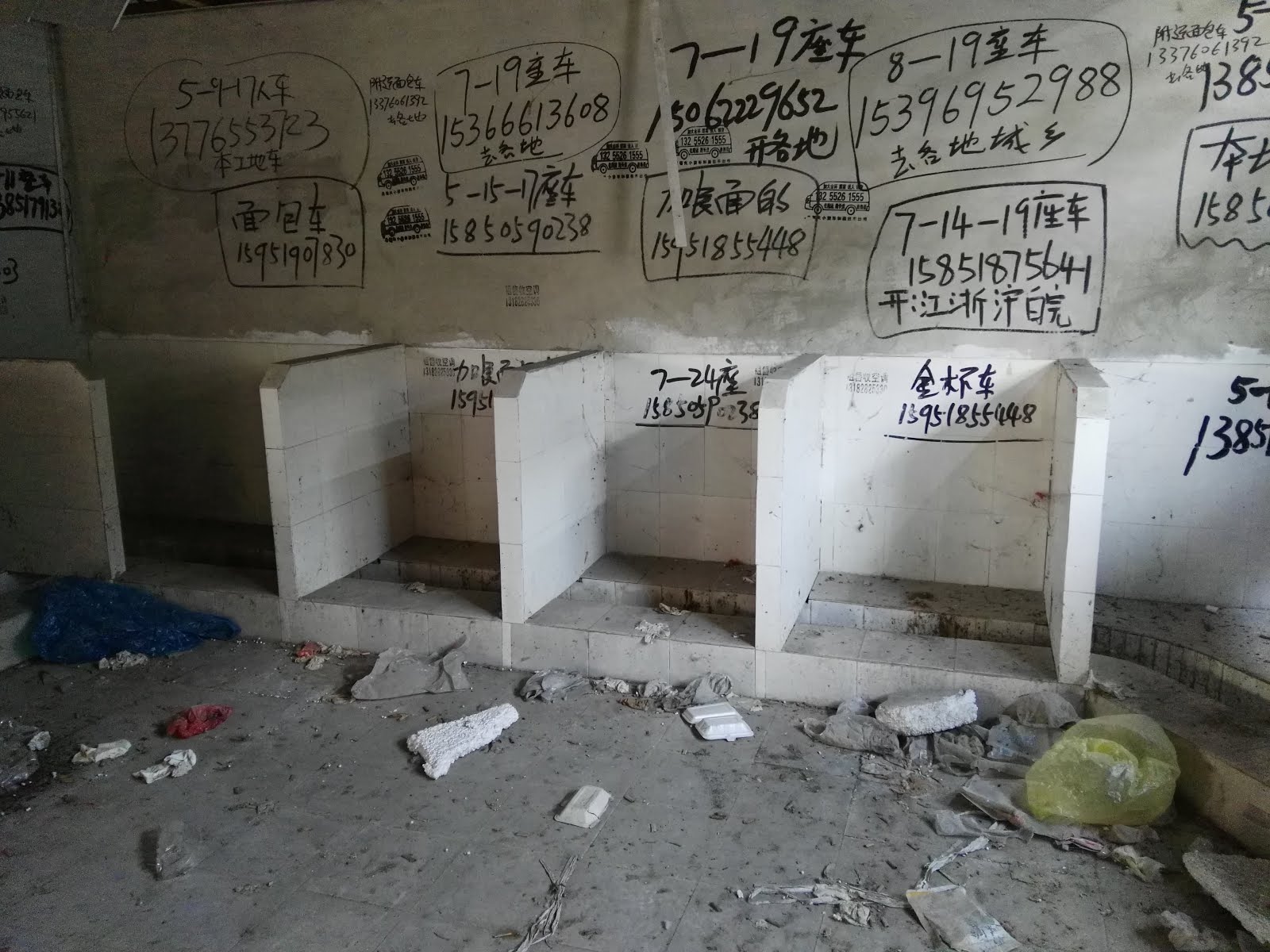
These are the toilets in an abandoned workers accommodation
Toilets in my school - It's 'delightful' when you go in and your boss is doing his business whilst having a smoke or, even worse, when its one of your students shouting 'Hello Teacher' at you. Thank god I have western style toilets in my apartment - which is on campus.

17. Most of the big shopping malls, department stores, restaurants, will
have toilet facilities. Most have the more traditional porcelain squat toilet
facilities. But some do have Western style toilets – for example Starbucks. In
most cases this are serviced very regularly by cleaning staff and are spotless.


18. If you do find a Western style toilet you might find the seat is broken
or the seat is up and there are footprints on the porcelain because some people
will hop up onto the toilet and use it as a squat toilet.
19. Toilet paper is not provided so you must carry your own supply – usually
little plastic bags of paper. Some of the toilets in the Malls have pay for
dispensing machines outside the entrance to the toilet.


20. Toilet paper is also not for flushing, the plumbing cannot cope so you
have to dispose of it in the bins provided.
21. The waste product is also used in the countryside and the vegetable
plots in the suburbs as manure. Alongside the country roads are pits of rotting
shit. This is ‘managed’ in that all the paper and sanitary towels etc is raked
out into a pile next to the pit and later burnt.
This is a local shit pit which once left for a while will be used as fertiliser - notice the sanitary products to the side.

This is a local shit pit which once left for a while will be used as fertiliser - notice the sanitary products to the side.

22. Instead of nappies, babies and toddlers wear trousers that are split
down the crotch so that they can be held over a sewer grate or just on the
sidewalk. I’ve seen kids being
held over the rubbish bins to piss on the metro station. Ive also seen a relatively old
kid, aged 6 or 7 having a shit on a piece of cardboard on the pavement as his
adoring grandma watches.

This mum, although the baby had a nappy on, undid the nappy to let the kid piss on the floor in the middle of the Mall - behind the wall in front of her are the public toilets.

Pee pee on the floor


This mum, although the baby had a nappy on, undid the nappy to let the kid piss on the floor in the middle of the Mall - behind the wall in front of her are the public toilets.

Pee pee on the floor

23. Men take a piss wherever they want.
24. People spit all over the place: on pavements, in
restaurants, in bars - everywhere. And its not just spitting there’s an
excruciating (to our ears) amount of hawking before the gob is spat onto the
floor. I’ve had it done next to me as I’ve been sat at a bar – at least in the
past we used spittoons. I once
took a plane to Thailand and I had some grandma sat behind me hawking up the
whole time.
25. Nose picking or just rooting around for a bit up there seems to be a
popular pastime on the metro and most other places really. Most people seem
oblivious to the gaze of each other and go about their business as if there was
no one else about. This is possibly a consequence of such a large population
with very little sense of personal space and privacy.

Digging deep

Digging deep
26. I’m British; the concept of queuing is embedded in my DNA. We queue for
everything. In China there is no
concept of queuing. In the
supermarket, where you get your vegetables weighed it’s a competition to get
your bag of apples onto the scales before the next person. At the train ticket
counter, there might well be a queue, but for some people that queue doesn’t
exist, it might just as well be in another dimension as they waltz to the front
of the queue, barge in and get served. The person behind the counter also
complicit in allowing the queue jumper to get served. But I have seen people complain and make people go to the back
and if Im in the queue I don’t stand for it either – its just not British – by
gad! Getting off a packed metro train onto the packed platform is a trial of
strength and will because as soon as the doors open the people on the platform
surge forward hoping to get one of the very few seats whist we, the poor
passengers fight to get off for fear of being trapped on the train for hours on
end in a never ending loop.
This is me at the supermarket, in the queue. The marrow to the left is a grandma using the first on the weighing scales, first served method. Nobody ever says anything least of all the girl on the till.

27. Being stared at by an open mouthed Chinese person who is
gobsmacked at there being a foreigner on the metro or on the street is pretty
normal. In China it is perfectly alright to stare at strangers and then take
their photos or demand a selfie with you – or in one case, as happened to
myself, be asked ‘why is your nose so big’?


28. The Chinese are not shy about asking personal or intimate questions.
Such as the above – ‘Why is your nose so big?’ or ‘Why are you so fat?’ or ‘How
old are you?’ or ‘Are you married?’
29. Personal space is not respected that much either colleagues have reported students and random people
touching their hair, because they'd never felt it before. For some reason some
of the girls in my school like to pat my belly (which is not so large and which
makes me feel uncomfortable for many obvious reasons) but they just laugh – maybe
it’s a Buddha thing for luck!
Chinese on the beach
On the metro is always a busy time

Chinese on the beach

On the metro is always a busy time

30. Chinese men generally don't seem to use deodorant or antiperspirant. I
think some Chinese people really don't like it at all and think it is quite
unpleasant. I mentioned above that some Chinese think we smell bad. Nevertheless
Chinese people don't seem to suffer from the same BO smell that plagues western
people, especially in the really hot and humid summers. The Chinese don’t seem
to sweat as much as we do. Plus many will shower twice a day and thus don't
require such heavy deodorant use.
Its difficult, but not impossible to find
deodorant and antiperspirant in the shops. This deodorant is in a 'Japanese' 10 rmb shop called Miniso - but it is difficult to find in general chemists and supermarkets.


31. It's also hard for women to buy tampons – sanitary towels are the
solution of choice for most Chinese women it seems – there are long rows/whole
aisles of sanitary towels in the supermarkets but they might only carry a few
boxes of tampons. In the countryside or the more rural areas they might be even
more difficult to find.
The whole of this left hand aisle is sanitary towels. There was 1 box of tampons amongst the lot.
The whole of this left hand aisle is sanitary towels. There was 1 box of tampons amongst the lot.

32. How many layers of clothing people wear. When it is just starting to get
nice and cool after the baking summer and I’m still walking around in shorts
and T-Shirts people start to wear their winter long johns and thermal
underwear. They would show off their three to four layers, peeling the layers
off their wrist. Colleagues would stop me in the school as I was just wearing a
shirt and ask me if I was cold. People seemed very impressed that I didn't fear
the cold and wore so few layers.
These guy were brave going for a swim in a mountain lake in March but perfect for showing off the layers
These guy were brave going for a swim in a mountain lake in March but perfect for showing off the layers


33. Its always suprising to see how much underwear can you see line-drying
outside windows as you walk down the street. Usually big grandma pants flapping
away in the wind and in the poorer neighbourhoods you can see how well
time-served they are from the patches and darns in them


34. How few clothes people own. Some people would wear the same clothes for
a whole week – this of course is a generalization but because of the huge gap
between rich and poor – those who are not so well off will not have so many
outfits to wear. Chinese friends are surprised at the number of shirts I have
though.
35. It’s not unusual to see people exercising in their normal/work clothes.
One my campus I regularly see teacher jogging around the track in their suits.
In a country that practically makes all the sports paraphernalia and clothing
in the world you would thing sports clothing would be de-rigueur. Teachers also
come into the little gym we have and jump on the machnes for a few minutes but
still in their ‘work clothes’. Even my school students will go out to PE
lessons and do the exercises in the clothes they are wearing and in the summer
come back into class soaking in sweat – the boys mainly, of course – with the
attendant smells – see above!
36. Fashion is big in China. So big that it’s not unusual to go to the parks
and mountains to see girls tottering up the rocky trails in really high heels
and sparkly outfits. But saying that having hiked a lot in the UK up mountains
you do tend to see similar
mistakes
37. Despite the influence of fashion there is little self-expression allowed
in school. All students wear the same tracksuits in summer and the same winter
uniforms. Dyed hair is not
allowed. Makeup is not allowed. Dating is not allowed.
38. Getting a haircut
in China can be a risky business give the lack of languages skills by both
parties. But generally the cutters are pretty good. In the first placed I lived
with a large student population there were lots of hairdressers to choose from
– but which one. My tactic was to
choose the hairdressers with the gayest looking boys in there with the most modern
haircuts as I assumed they would know what they were doing. It seemed to work
for me. Most cheaper hairdressers seem identical. A bunch of fashionable guys
(I’ve not seen girls cutting) with cheesy music blasting from some outdoor
speakers. My haircut is around £4. Plus they wash your hair before and after
the haircut.
Me getting a cut

Me getting a cut

39. And there are a lot of hair salons to choose from which makes the
choosing all the more difficult.
40.
Generally people don’t seem to
have as much ‘stuff’ as we do in the West. I have been in many Chinese homes in
Anhui Province and locally and they are pretty spartan. In a big room there
might be a dining table a settee, some hard back chairs (suitable for said
table) a big screen TV perhaps a dresser. On the walls maybe some calligraphy
or a picture of Mao. That’s about it.


41.
In many places there is no
evidence of heating or AC – people just put on more clothing to keep warm and
keep the doors wide open. Obviously this probably doesn’t happen in the North -
Anhui province where I went, even in the mountains, is in the ‘warm’ south.


42.
Once upon a time some beaurocrat
member of the party drew a line across China, it stretches from Shanghai across
the country. Above that line it is ‘officially’ cold and below that line it is
‘officially’ warm. This means homes in the ‘warm’ south are not built with
insulation and decent heating.
43.
Throughout the year one will hear insanely long strings of firecrackers
constantly going off at the crack of dawn or late into the night. These are often set off to celebrate the
opening of a new store or a marriage procession along the motorway – they drive
away bad luck for the recipients but pollute the air for the rest of us. It had
got so bad that here in Nanjing the local government have banned
fireworks. We still hear them
occasionally but even at Spring Festival and New Year it was quite, unlike the
Chinese New Years eve I spent in Shanghai a few years ago where it was like
being in WW3 and the fireworks lasted over 24 hours.

Shanghai Chinese New Year


Shanghai Chinese New Year

44.
Karaoke, or as its called in China, KTV is huge. The places where you can go to
sing, badly and out of tune, are all over the place, its big business
here. In fact as it was my
birthday we went last weekend. The room cost around £35 (350rmb) for 5 people.
Yes, unlike Karaoke in the UK where its done in the bar of the local pub so you
can humiliate yourself in front of the rest of the punters whilst singing ‘Lady
in Red’ to your cringing girlfriend KTV in China is done in private rooms with
big screens, great sound systems and waiter service. Drinks are expensive and you can buy snacks. My 350 rmb
booked the room from 6pm to 2am – but we ate out first so go there around 9 and
spent 2 hours caterwauling. It is great fun.


45. During the winter months its not unusual to see sausages, fish and meats
curing on the clotheslines next to the pants or hanging on the boughs of a
handy tree or the telegraph/electric lines because they are drooping low
enough. After all why use a fridge when its cold enough outside.


46. It is quite jarring to see people who have shopped at the fish market, taking
the fish home alive and still flopping around in plastic bags. The fish section in the supermarkets
are also not the place to visit if you have any feelings for animal (fish)
welfare. Tanks are overfilled with gasping fish living out their last moments,
some are clearly damaged floating around upside down – its not a good
experience.


47.
Plastic bags from the supermarket
are hopeless as they are very thin and the type of bag one uses in the rubbish
bin are so thin I marvel at the technology used to make such thin bags and have
them on a roll at the same time.
48. If one is ill it is possible to go to a pharmacy and buy most things
your doctors back home would give you a prescription for. For example antibiotics
aren't regulated, so its easy to by Amoxicillin for example. The problem with
this is they are seen as a cure all and you will be told to take an antibiotic
even for a common cold or for a stomach ache.
49. Instant coffee is everywhere. Everyone loves Nescafé but in the little
sachets one buy its usually sugared so you end up with a hot sweet brown
coloured beverage that is masquerading as coffee. If you want real coffee and make the mistake of going into
one of the many ‘coffee’ houses such as Blue Mountain Coffee you will get a
small cup of very expensive, but good, coffee. Of course Starbucks and Costa sell western style coffee at
around 30rmb but Chinese chains such as 56 degrees (In Nanjing anyway) do
decent coffee for half that price and indeed KFC and McDonalds coffee is
bearable for a much smaller price.
This is my preferred brand in my office - hot water is always available in the hot water dispenser by the toilets

This is my preferred brand in my office - hot water is always available in the hot water dispenser by the toilets

50. Napping is the national ‘sport’ or habit. My students could nap for
China. Everywhere you go, at any time of day, people will be napping. In the
shops – IKEA runs regular announcements stating that the beds are for display
not sleeping in. But its not unknown for grandma’s and granddads to be left
napping in a chair whilst the family shops. People use restaurants like KFC,
McDonalds, Starbucks – all with AC and wi-fi as handy places to nap – you don’t
even have to purchase anything. I’ve even had to ask staff to wake people up
and move them so I could sit down with my purchase –this is done without so
much as a murmur of dissent.
People nap on bikes, in carts, on the metro actually anywhere and
everywhere is codusive to 40 winks or more. The Chinese teachers have camp beds in the office for the
lunch time nap.


Note - all of the photographs on this blog are mine except for one or two - if they are yours and you don't want them here contact me and I will remove them. If you use my photos please do try to contact me about their use.


Note - all of the photographs on this blog are mine except for one or two - if they are yours and you don't want them here contact me and I will remove them. If you use my photos please do try to contact me about their use.


